OCD Training for Therapists: ERP and I-CBT Resources
This page is a clinician-focused reference for mental health professionals seeking specialized training in Obsessive-Compulsive Disorder (OCD), including Exposure and Response Prevention (ERP) and Inference-Based Cognitive Behavioral Therapy (I-CBT).
It is not an exhaustive list. Instead, it reflects commonly referenced trainings, learning communities, and foundational resources used by clinicians pursuing post-graduate OCD education.
Why Specialized OCD Training Matters
Despite its prevalence, Obsessive-Compulsive Disorder is often underrepresented in graduate training and general CBT coursework. Many clinicians receive limited formal education in:
Recognizing OCD across presentations and subtypes
Differential diagnosis (e.g., OCD vs. Generalized Anxiety Disorder (GAD), trauma-related disorders, psychosis)
Identifying reassurance and accommodation as compulsions in therapy
Understanding how certain therapeutic approaches can reinforce OCD symptoms
Knowing when to treat within scope and when to refer
Because of this, specialized OCD training and consultation are strongly recommended for clinicians working with OCD.
OCD.xyz trainings are available for NBCC-approved continuing education credit (ACEP No. 8051).
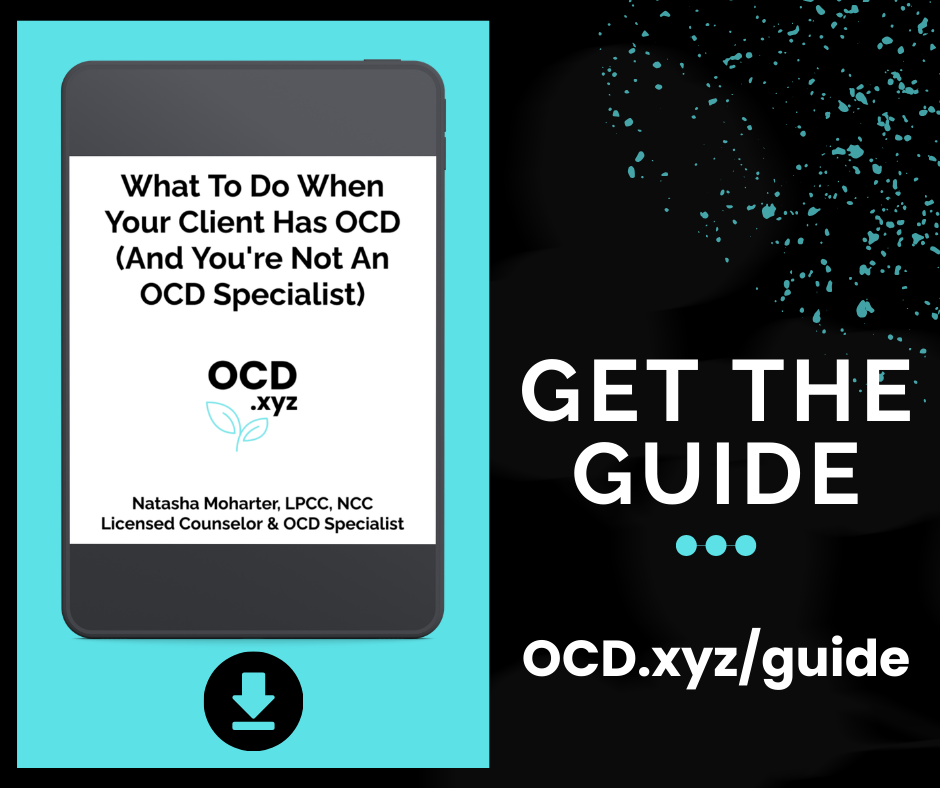
Not ready for full training yet? Start with my free guide:
”What to Do When Your Clients Have OCD and You're Not an OCD Specialist.”
Get practical next steps you can use immediately. ⬇️
Foundational OCD Training Organization
International OCD Foundation (IOCDF)
The International OCD Foundation (IOCDF) is a central organization in OCD education, research, and professional training.
IOCDF offerings commonly include:
Professional workshops and webinars
Annual conferences
Evidence-informed clinical resources
Training programs focused on accurate diagnosis and treatment planning
Many clinicians use IOCDF programming as a foundation for ongoing OCD education.

ERP (Exposure and Response Prevention) Training for Clinicians
ERP is a well-established treatment approach for OCD. Effective ERP training goes beyond learning exposure exercises and emphasizes clinical reasoning and therapist behavior.
High-quality ERP training typically addresses:
Functional assessment of compulsions and avoidance
Therapist accommodation and reassurance
Subtype-specific considerations
Ethical and scope-of-practice guidance
Recommended ERP Training Programs
The following ERP trainings are commonly referenced by clinicians seeking specialized OCD education:
Behavioral Therapy Training Institute (BTTI) – International OCD Foundation
An intensive, application-focused ERP training widely regarded as a foundational experience for clinicians. The program includes a 3–4 day live training followed by approximately three months of ongoing group consultation.Cognitive Behavioral Institute (CBI) – 4-Day ERP Training
A structured, immersive training focused on practical ERP implementation, with optional opportunities for ongoing consultation.OCD.xyz
Offers ERP training cohorts for mental health professionals seeking structured, small group-based learning in OCD treatment.
Learn More About OCD.xyz ERP TrainingCBT School
An on-demand training to help you learn compassion-focused OCD treatment using ERP.Bull City Anxiety & OCD Treatment Center
Provides training and consultation opportunities focused on ERP and the treatment of OCD and related anxiety disorders.Center for Anxiety & Behavior Therapy
Provides foundational and advanced training in ERP for OCD along with opportunities for consultation.NOCD Academy
Provides ERP-focused training and education for clinicians treating OCD, with an emphasis on applied clinical skills and ongoing learning opportunities.
The IOCDF also has a list of Education & Training Programs with an Emphasis on OCDon their website. This includes graduate programs, practicum sites, internship sites, post-doctoral/post-degree training, and psychiatry residency training programs.
ICBT (Inference-Based Cognitive Behavioral Therapy) Training
Inference-Based CBT (ICBT) is a cognitive treatment model developed specifically for OCD. It differs meaningfully from traditional CBT and should not be implemented without formal training.
Because of its distinct theoretical framework, formal ICBT training is recommended prior to clinical use.
Recommended ICBT Training Program
OCD Training School
Offers education focused on the ICBT model and its clinical application to OCD.The Center for Emotional Health
Offers 10-hour, on-demand comprehensive ICBT training.Cognitive Behavioral Institute (CBI)
Offers an introductory, on-demand, 4.5 hour training in ICBT.
OCD.xyz Live & Home-Study CE Trainings
OCD.xyz offers NBCC-approved continuing education trainings (ACEP No. 8051) designed specifically for mental health professionals working with OCD. Training topics focus on differential diagnosis, recognizing OCD across presentations, and evidence-informed treatment approaches.
Trainings are available in live and home-study formats. Programs that do not qualify for NBCC credit are clearly identified. OCD.xyz is solely responsible for all aspects of the programs.

OCD Consultation and Case Support for Clinicians
In addition to formal training, it is highly recommended that clinicians seek ongoing consultation to support clinical decision-making, differential diagnosis, and treatment planning for OCD.
Consultation is particularly helpful when:
Presentations are complex or unclear
Progress stalls or treatment feels “stuck”
Clinicians are newer to OCD-specific work
Scope-of-practice or referral questions arise
Places Clinicians Commonly Find OCD Consultation
International OCD Foundation (IOCDF)
Consultation groups and case-based learning opportunities connected to conferences, professional trainings, and IOCDF-affiliated events
Specialty OCD Treatment Centers
Many OCD specialty clinics offer group consultation, one-to-one case consultation, or clinician learning opportunities, including:
(Availability, format, and eligibility vary by organization.)
Training Organizations Offering Consultation
Some ERP and ICBT training programs include or offer follow-up consultation options, such as:
Behavioral Therapy Training Institute (BTTI) – International OCD Foundation
Cognitive Behavioral Institute (CBI)
OCD Training School (ICBT)
OCD.xyz Consultation
In addition to the options above, OCD.xyz offers consultation services for clinicians seeking support with:
Differential diagnosis
Treatment planning
Clinical implementation of ERP

Professional Communities and Facebook Groups
Clinician-focused spaces that support ongoing learning, discussion, and exposure to OCD-related clinical material:
OCD / Anxiety / BFRB Specialists (Facebook group)
Inference-Based Cognitive-Behavioral Therapy for OCD and Related Disorders (Facebook group)
OCD SoCal – Live Monthly Support Group
A clinician-attended, live monthly support group that provides ongoing exposure to OCD presentations and is often cited as a valuable learning opportunity.

📖Recommended Books for OCD Clinicians
ERP
Foa, E. B., Yadin, E., & Lichner, T. K. (2012)
Exposure and Response (Ritual) Prevention for Obsessive-Compulsive Disorder
(Treatments That Work Series)
A widely referenced text providing a structured, evidence-informed overview of ERP.
ICBT
O’Connor, K., & Aardema, F. (2012)
Beyond Reasonable Doubt: Reasoning Processes in Obsessive-Compulsive Disorder and Related Disorders
A foundational text for understanding the theory and clinical application of ICBT.
Aardema, F. (2024)
Resolving OCD: Understanding Your Obsessional Experience (Volume 1)Aardema, F. (2025)
Resolving OCD: Understanding Your Obsessional Experience (Volume 2)
Clinically oriented texts that outline the practical application of ICBT principles in OCD treatment.

Certification vs. Clinical Competence
Some OCD trainings offer certificates or formal designations. While these may be useful, they do not replace:
Ongoing consultation
Experience with diverse OCD presentations
Continued education and ethical referral practices
It is also important to note that there is currently no nationally or internationally recognized certification in ERP or ICBT.
Clinical competence in OCD treatment develops over time through layered learning, consultation, and supervision rather than through any single credential.
Additional OCD Education and Consultation
OCD.xyz offers continuing education and consultation for mental health professionals focused on:
Differential diagnosis
Treatment planning and clinical decision-making
Integrating evidence-informed OCD approaches into practice
These offerings are designed to complement comprehensive OCD training programs.

Frequently Asked Questions About OCD Training (ERP & ICBT)
What training is recommended for therapists working with OCD?
Mental health professionals working with OCD are strongly encouraged to pursue specialized post-graduate training. This often includes education in Exposure and Response Prevention (ERP), Inference-Based Cognitive Behavioral Therapy (ICBT), differential diagnosis, and ongoing consultation. Graduate programs typically provide limited OCD-specific training.
Is ERP training required to treat OCD?
While no single training is legally required in most jurisdictions, ERP-specific training is strongly recommended for clinicians treating OCD. ERP is a structured intervention that requires clinical judgment, careful formulation, and awareness of common treatment pitfalls such as reassurance and accommodation.
What is the difference between ERP and ICBT training?
ERP (Exposure and Response Prevention) focuses on reducing compulsive behaviors through exposure and response prevention, while ICBT (Inference-Based CBT) targets the reasoning processes and doubt mechanisms that maintain OCD. ERP and ICBT are distinct treatment models and should not be implemented without formal training specific to each approach.
Do I need certification to treat OCD?
Some OCD trainings offer certificates or formal designations; however, there is currently no nationally or internationally recognized certification in ERP or ICBT. Certification alone does not equal clinical competence. Effective OCD treatment typically involves a combination of specialized training, ongoing consultation, experience with diverse OCD presentations, and ethical referral practices when cases exceed a clinician’s scope.
Where can therapists find OCD consultation groups?
Clinicians often find OCD consultation through:
IOCDF-sponsored consultation opportunities
Specialty OCD treatment centers
ERP or ICBT training organizations that offer follow-up consultation
Professional peer consultation groups focused on OCD
Consultation is especially helpful for complex cases, differential diagnosis, and treatment planning.
Is ICBT appropriate for all OCD presentations?
ICBT is not appropriate for every presentation. Formal ICBT training includes guidance on client selection, contraindications, and clinical decision-making. Clinicians are encouraged to seek training and consultation before integrating ICBT into practice.
Are online OCD trainings effective for clinicians?
Online OCD trainings can be effective when they are specialized, evidence-informed, and designed for clinicians. Trainings that include case examples, clinical decision-making, and opportunities for follow-up consultation tend to be more beneficial than purely theoretical coursework.