OCD Advocacy & Why It Matters
The International OCD Foundation (IOCDF) has been around since 1986, and they play a key role in increasing awareness, improving access to effective treatment, educating clinicians, supporting research, and building a community for people who have Obsessive-Compulsive Disorder (OCD) and their families.

I joined the IOCDF as a professional member in 2022. I had been engaging in ongoing training and consultation about OCD, and I really wanted to connect with the OCD community at large. The “international” part intrigued me. It speaks to the reality that OCD affects everyone—across cultures, identities, ages, and backgrounds—and that our efforts to raise awareness and increase access to effective treatment matter on a much bigger scale.
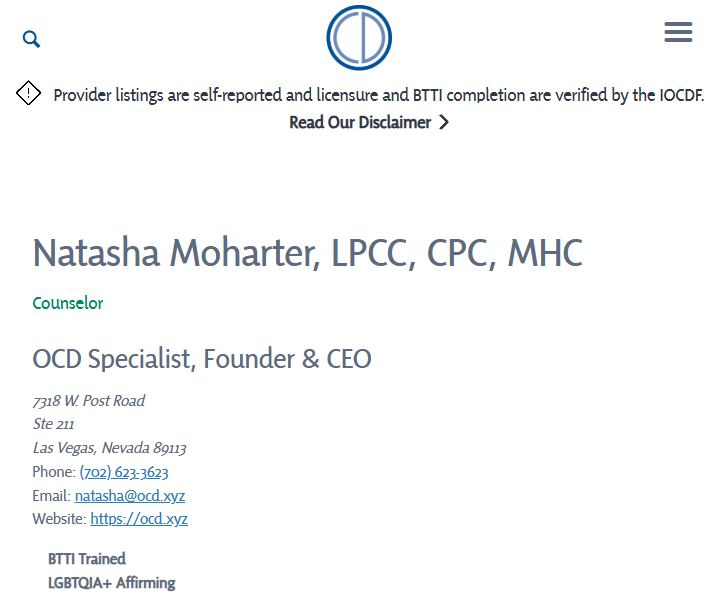
During that time as a professional member, I attended trainings and used several of the resources on the IOCDF website to share accurate and helpful information with my clients and colleagues. I also set up my IOCDF Directory Profile which has helped clients with OCD find me.
In 2023, I became a Grassroots Advocate with the IOCDF. Around that time, I began hosting virtual CE trainings about OCD for my community, offering free drop-in group consultation sessions for mental health professionals, and tailoring my content more intentionally to OCD. I saw a major need and an underwhelming amount of accurate information out there. The gap between what people with OCD actually experience and what most people (including many clinicians and medical providers) understand about OCD is big—and it harms people. Those of us in the helping professions got into these fields to help, yet not understanding OCD can do just the opposite.

People with OCD are at increased risk for suicidal ideation, depression, anxiety, substance use struggles, and significant functional impairment.
🩵OCD awareness is suicide prevention.
🩵OCD awareness is substance use prevention.
🩵OCD awareness is early intervention.
It takes on average approximately 14-17 YEARS to receive effective treatment for OCD (Ziegler, et al, 2021). When clinicians and communities understand OCD clearly, people get help sooner—and recovery becomes more possible.
My advocacy is personal.
I have lived with OCD since I was a child. I had contamination OCD, but never knew OCD could be more than that. The media often portrays cleaning, organization, and symmetry, but the mental hoops OCD makes you jump through can be harder to show.
I struggled with other themes throughout my life without having the language for it. In my early 20s, I was hit with the worst relationship OCD (ROCD) symptoms I had ever experienced. I had no idea what ROCD was. I felt tormented daily. It led to depression. I doubted everything. It put a strain on the relationship with my spouse that I wanted and cherished so much—OCD made it its #1 target for years.

I look back and feel grateful my spouse and I made it through that dark time, and I also grieve what could have been if OCD hadn’t been such a central force during those years.
And I was in therapy during that time. My therapist and my doctor told me it was Generalized Anxiety Disorder and prescribed a selective serotonin reuptake inhibitor (SSRI). Years later, I learned I likely have bipolar disorder as well, and an SSRI could have (and likely did) trigger a hypomanic episode. You can read more on this topic here.

OCD awareness could have helped my therapist know how to actually help treat the symptoms or refer me to someone who could. And OCD treatment doesn’t have to take a long time. On average, Exposure and Response Prevention therapy (ERP)—the frontline treatment for OCD—lasts about 12–25 sessions for many people, depending on severity and complexity (Foa et al., 2012).
It could have helped me receive the right intervention sooner.
It could have prevented me from feeling like a test subject for various medications while trying to find the “right” one.

And I see this clinically all the time:
OCD increases the risk of suicide—not because people want to die, but because the weight of untreated OCD becomes unbearable.
Fears of being a bad person, harming others, doing something against ones morals, not having enough energy to complete every compulsion OCD demands, the pressure to feel “just right”—the list goes on. I’ve seen clients go from fearing suicide in Harm OCD to developing actual suicidal ideation because the disorder feels so heavy, isolating, and relentless.
This is why advocacy matters.
This is why education matters.
Awareness saves lives.
Effective training changes treatment.
Accurate information reduces suffering.
And advocacy is the bridge that connects all of those things.
I’m so excited to share that I applied to become an IOCDF Advocate in early 2025, and received notice in October 2025 that I was selected for the program. It involves a 2-year commitment and feels like the natural next step on my journey as an OCD specialist.
I’m honored to jump into this new role as an IOCDF Advocate, and I’m committed to continuing the work that literally saves lives and helps more people understand OCD, find effective treatment, and feel less alone in their experience.