"What If I Snap?" Understanding Postpartum OCD & Postpartum Psychosis in the Wake of Tragic Headlines
When high-profile media cases highlight tragic events involving Postpartum Psychosis, shockwaves ripple through the parenting and mental health communities. But for individuals living with Perinatal / Postpartum OCD or Harm OCD, these headlines do not just evoke sympathy—they can trigger an intense, visceral panic.
If you struggle with intrusive harm thoughts, your brain might immediately hijack the news story:
"What if that happens to me?"
"What if I lose control and hurt someone I love?"
"What if I'm secretly on the verge of losing my mind?"
It is vital to know this upfront: OCD—whether Perinatal / Postpartum OCD or general Harm OCD—is fundamentally different from Postpartum Psychosis. Experiencing horrific, unwanted intrusive thoughts does not mean you are losing touch with reality, nor does it mean you are slipping into psychosis. According to clinical experts at the International OCD Foundation (IOCDF), there is zero evidence that Perinatal / Postpartum OCD can "turn into" postpartum psychosis—they are entirely separate conditions.

A Quick Note on Terminology: Perinatal vs. Postpartum OCD
Clinicians often group these conditions together because they share the same underlying anxiety cycle, but the main difference comes down to timing:
Perinatal OCD occurs during pregnancy, with obsessions often focusing on unborn baby safety, prenatal contamination, or food/medication intake.
Postpartum OCD occurs after delivery, with obsessions centering on newborn care, accidental harm, or intrusive thoughts around the infant.
Note: Because both stem from biological shifts and the immense weight of parental responsibility, these themes can affect birthing parents, non-birthing partners, adoptive parents, and primary caregivers alike.

1. The Language Trap: "Intrusive Thoughts" in OCD vs. Psychosis
Part of the confusion stems from psychiatric language itself. Mental health professionals and media reports often use the phrase "intrusive thoughts" when discussing both OCD and psychosis, but the human experience behind them is completely different:
In OCD, an intrusive thought is an Unwanted Alarm. Your brain generates a distressing thought, image, or urge, but you immediately recognize it as unwanted, frightening, and completely incompatible with who you are.
In Psychosis, a psychotic thought is a False Reality. The brain creates a belief or vision that the person perceives as an absolute, objective fact.
In Perinatal / Postpartum & Harm OCD: Unwanted Alarms
An intrusive thought in OCD is an uninvited mental pop-up—an unwanted thought, urge, image, doubt, or "what-if" question. In Perinatal / Postpartum OCD, these thoughts often center on accidental harm, contamination, fear of losing the baby, or distressing sexual harm obsessions.
Because these thoughts are ego-dystonic (completely opposite to your true values and character), the brain misinterprets the random mental noise as a severe threat. This triggers an overwhelming wave of fear and guilt, driving the parent to perform protective compulsions or avoid their baby in a desperate attempt to keep them safe.
In Postpartum Psychosis: False Reality (Delusions & Hallucinations)
In Psychosis, what the media sometimes calls "intrusive thoughts" are actually delusions (fixed, false beliefs) or hallucinations (seeing or hearing things that are not there, such as seeing smoke coming from the baby's ears or hearing command voices).
The brain loses touch with reality: The line between a person's inner thoughts and the real world disappears. The thought does not feel like a "scary idea"—it feels like an absolute fact.
How the brain reacts: The person does not feel panic because they had an "unwanted thought." Instead, they act because they believe their altered reality is real (for example, believing their baby is possessed by evil, or believing that harming the baby is a distorted act of mercy).
The result: Their actions are driven by this altered reality. Tragically, in severe cases of delusional altruism, a parent in psychosis may genuinely believe that ending the child's life is an act of compassion to "save" them from an imaginary evil or a lifetime of suffering.

2. Ego-Dystonic vs. Ego-Syntonic: The Mindset Boundary
The single biggest clinical distinction between OCD and Psychosis comes down to how the thought aligns with your core sense of self.
Perinatal / Postpartum & Harm OCD: Ego-Dystonic
Ego-dystonic means the thoughts, images, or urges run completely counter to your values, identity, and desires.
You do not want to act on these thoughts. You spend massive amounts of energy trying to escape them, prevent harm, and ensure your loved ones remain safe.
Clinical research demonstrates that because these thoughts are ego-dystonic, individuals with Perinatal / Postpartum OCD do not act on their intrusive thoughts. The overwhelming anxiety reflects a desperate desire to keep the baby safe, not an intent to cause harm.
Postpartum Psychosis: Ego-Syntonic / Delusional
Within the psychotic state, delusional beliefs feel real, necessary, or even morally right to the individual (ego-syntonic relative to their altered state).
A person in psychosis does not register the idea as an unwanted OCD intrusion. To them, the delusion feels like a devastating necessity—such as believing they are protecting their child from a worse fate—which is why they do not experience the typical OCD panic and protective avoidance behaviors.
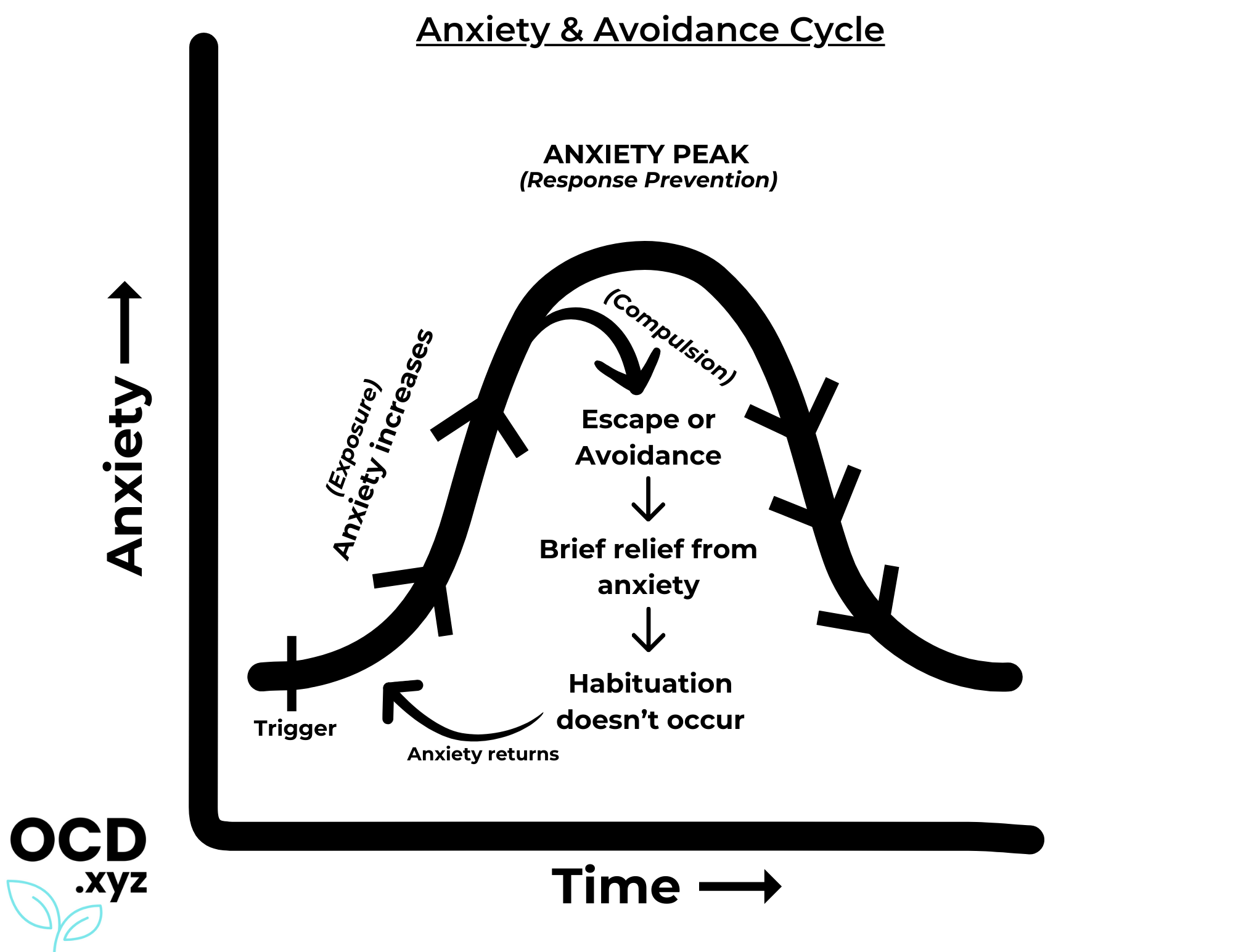
3. The OCD Cycle vs. Postpartum Psychosis: How the Engine Works
To understand why OCD and Psychosis are completely different, it helps to look at what drives the behavior in each condition.
The 4 Steps of the OCD Cycle
In Perinatal / Postpartum OCD and Harm OCD, every behavior belongs to a four-part cycle:
Obsession: An intrusive, unwanted thought, image, or urge pops up (for example, "What if I drop the baby down the stairs?").
Anxiety & Panic: The person reacts with intense horror, guilt, and fear because the thought goes against their true character and morals.
Compulsion / Safety Behavior: To stop the fear or protect the baby, the person performs a ritual or avoidance behavior (such as hiding knives, refusing to carry the baby on stairs, or asking a partner for reassurance).
Temporary Relief: The compulsion provides a brief moment of relief, but it reinforces to the brain that the thought was dangerous—keeping the fear loop alive.
Why This Cycle Is NOT Present in Postpartum Psychosis
Postpartum Psychosis does not follow this cycle.
In psychosis, there is no obsession-compulsion feedback loop. A person in a psychotic state does not experience an unwanted thought, feel horror about it, and try to perform a protective compulsion to prevent it. Instead, the brain's perception of reality itself is altered. Their actions are not compulsions meant to neutralize an unwanted fear; they are direct responses to delusions (fixed false beliefs) or hallucinations (hearing voices or seeing things) that feel completely real to them.

4. Beyond Postpartum: Harm OCD and the Fear of "Going Crazy"
You don't need to be a new parent to be triggered by headlines about psychosis. People struggling with general Harm OCD or "Going Crazy" OCD themes (dementophobia) experience the exact same spiral.
Self-Harm vs. Harm to Others in OCD
Harm OCD isn't limited to thoughts of hurting someone else. It frequently presents in two ways (and often both):
Fear of Harming Others: Intrusive images or urges of harming a loved one, a child, or a stranger, followed by intense guilt and protective avoidance.
Fear of Harming Yourself (Self-Harm OCD): Intrusive "what-if" thoughts about jumping, swerving a car into oncoming traffic, or using a sharp object on oneself.
Crucially, Self-Harm OCD is distinct from actual Suicidal Ideation:
In Self-Harm OCD, the intrusive thought is terrifying and unwanted—the person desperately wants to live and fears losing control.
In Suicidal Ideation (which can co-occur with OCD, especially when comorbid depression is present), thoughts of death stem from hopelessness or a desire for relief from suffering, rather than a fear of losing control.
While both require compassionate mental health support, clinicians treat them differently: Self-Harm OCD responds best to specialized OCD therapy (like ERP or I-CBT), whereas suicidal depression focuses on mood stabilization, safety planning, and emotional regulation.
The Fear of Losing Control
When news stories cover a psychotic break or tragic loss of life, people with OCD experience intense catastrophic thinking:
"What if I'm secretly capable of snapping like that?"
Sanity Checking: Hyper-analyzing internal thoughts ("Was that normal? Did I hear something?").
Equating Intrusions with Psychosis: Fearing that a vivid, distressing image means they are on the threshold of a psychotic break.
The Paradox of Sanity Checking: The very act of hyper-analyzing your mental state and worrying about losing touch with reality proves that your reality testing is functioning normally. People in active psychosis do not monitor their thoughts to see if they are losing sanity—their reality has already shifted without them questioning it.
Related Reading: Want to learn more about how intrusive thoughts function outside of the postpartum period? Read our comprehensive guide on Understanding Harm OCD and Intrusive Thoughts.

5. Compulsions vs. Delusional Actions: Driven by Fear vs. Driven by Reality
Just as thoughts differ between OCD and Psychosis, the behaviors that follow those thoughts are completely distinct. Looking closely at why someone is performing a behavior—and what they hope to accomplish—reveals the sharp contrast between an OCD compulsion and a psychotic action.
OCD Compulsion: Driven by panic to PREVENT a fear from happening.
Psychotic Behavior: Driven by an altered reality to ACT ON a delusion that feels true.
OCD Compulsions: Protective, Hyper-Vigilant, and Restrictive
In OCD, compulsions (both physical and mental) are rituals performed to reduce anxiety, seek certainty, or prevent the feared harm from occurring. Because the intrusive thought feels terrifying, the person’s entire behavior becomes focused on safety and containment:
Avoidance: Hiding kitchen knives in locked drawers, refusing to be alone with the baby, avoiding essential tasks like diaper changes, bathing, or using stairs with the baby, or needing a partner nearby at all times.
Checking & Sanity Inspection: Re-checking that the baby is breathing dozens of times, scanning one’s own body for "bad impulses," or asking a partner repeatedly: "You know I love our baby, right? I would never hurt them, right?"
Mental Review: Ruminating on past moments, repeating prayers, or mentally replaying interactions with the child to "prove" there was no intent or sensation of harm.
Safety Behaviors: Keeping hands clenched in fists, wearing oven mitts, or hiding away from triggers.
Pattern Note: Perinatal / Postpartum OCD symptoms can heavily interfere with child care, bonding, and sleep, and often co-occur with Postpartum Depression (PPD). The parent locks themselves away or hands off caregiving tasks in a desperate effort to protect the child from themselves.
Psychotic Behaviors: Guided by an Altered Reality
In Postpartum Psychosis, behaviors are not protective rituals designed to stave off a fear. Instead, the person’s actions are a direct, logical response to an altered perception of reality (a delusion or hallucination):
Responding to Delusional Logic: A parent might perform an unusual or dangerous act because they believe it is required to save the baby's soul, clean the baby of "contamination," or protect the child from imaginary malevolent forces.
Acting on Command Hallucinations: Responding directly to auditory hallucinations (voices instructing them to take specific actions).
Bizarre or Disorganized Behavior: Sudden rapid shifts in mood, erratic movements, speaking in fragmented sentences, or displaying severe paranoia.
Lack of Protective Concealment: Unlike the parent with OCD—who goes to extreme lengths to hide knives and avoid harm—a person in psychosis is acting out of a broken perception of reality and usually does not recognize that their behavior is ungrounded or dangerous.

6. Core Differences at a Glance
Prevalence: Perinatal / Postpartum OCD occurs in roughly 1% to 5% of pregnant or postpartum parents. Postpartum Psychosis is extremely rare, occurring in approximately 0.1% of births (1 to 2 per 1,000).
Nature of Thoughts: OCD involves intrusive, unwanted images, urges, or "what-if" scenarios (harm, contamination, sexual obsessions). Psychosis involves delusions, hallucinations, and a detached reality.
Relationship to Self: OCD thoughts are ego-dystonic (distressing, repulsive, opposite of true desires and morality). Psychotic thoughts are delusional (believed to be true or necessary within the altered state).
Individual's Reaction: OCD triggers extreme terror, guilt, hypervigilance, avoidance, compulsions, and fear of being diagnosed with psychosis or hospitalized if they speak up. Psychosis presents with confusion, altered mood, and a total lack of awareness that beliefs are false.
Behavioral Goal: OCD behaviors aim to protect loved ones and neutralize anxiety over the thoughts. Psychotic behaviors are driven by delusional logic or responding to command hallucinations.
Care Required: OCD requires specialized outpatient mental health care (ERP/I-CBT). Psychosis is an immediate medical emergency requiring inpatient evaluation.

7. How Treatments Differ (and Where They Overlap)
Because the underlying mechanisms of OCD and Psychosis are fundamentally different, their treatment pathways diverge sharply.
Specialized Therapy for Perinatal / Postpartum & Harm OCD
A Critical Note on Therapy: Traditional, general CBT (such as challenging "negative" thoughts, reframing beliefs, or analyzing evidence) is ineffective and often harmful for OCD. Attempting to logically debate or reframe an intrusive thought acts as a mental compulsion (rumination), which unintentionally fuels the OCD cycle.
Effective OCD treatment relies on specialized protocols:
Exposure and Response Prevention (ERP): Considered the behavioral gold standard for OCD. ERP helps individuals gradually confront triggering situations (like holding a kitchen knife or carrying the baby near stairs) while learning to resist compulsions, safety rituals, and avoidance. Over time, the brain learns that intrusive thoughts do not require a protective response.
Inference-Based Cognitive Behavioral Therapy (I-CBT): A specialized, evidence-based therapy designed specifically for OCD. Unlike traditional CBT or ERP, I-CBT does not focus on anxiety habituation or exposure. Instead, it targets the "upstream" reasoning error (called inferential confusion) that creates the obsessive doubt in the first place. I-CBT helps individuals recognize how OCD pulls them out of direct reality and into imagined scenarios, restoring trust in their senses, common sense, and true character.
Diagnostic Accuracy & Medication Considerations
Accurately distinguishing OCD from other mental health and medical conditions is essential—especially as it relates to Postpartum Psychosis (PPP). Because symptoms like intrusive thoughts, panic, severe mood shifts, and reality distortions can overlap in appearance, a proper differential diagnosis dictates whether a patient receives standard outpatient therapy or immediate medical stabilization.
1. Why Differential Diagnosis Matters for Treatment:
Medication Strategies Are Radically Different: For OCD, antidepressants (SSRIs like Lexapro, Zoloft, or Prozac) are the primary medication used to calm the brain's alarm system and reduce obsessive thoughts. However, for conditions involving psychosis or mania, taking an SSRI by itself doesn't work—and can actually be dangerous, as it risks triggering a manic episode or worsening psychotic symptoms.
Broad Spectrum to Rule Out: Clinicians must carefully distinguish OCD from primary perinatal anxiety/mood disorders (Postpartum Depression, Postpartum Anxiety, Postpartum PTSD), psychotic and mood spectrum disorders (Bipolar I & II, Major Depression with psychotic features, Schizophrenia), and organic medical causes (such as postpartum thyroiditis, autoimmune encephalitis, severe sleep-deprivation delirium, or infection/sepsis).
2. Treatment for Postpartum Psychosis (An Immediate Emergency): Unlike OCD—which is managed through specialized outpatient therapy like ERP or I-CBT—Postpartum Psychosis is a psychiatric emergency that develops rapidly (usually within 1–2 weeks postpartum). Treatment includes:
Emergency Psychiatric Evaluation: Immediate admission to a specialized perinatal or inpatient psychiatric unit to ensure total safety for both parent and baby.
Medical & Pharmacological Stabilization: Rapid administration of antipsychotic medications, mood stabilizers, and short-term sedatives to break the psychotic state and restore neurochemical balance.
Electroconvulsive Therapy (ECT): A safe, highly effective, and fast-acting medical procedure performed under brief general anesthesia. ECT is frequently used in urgent cases of Postpartum Psychosis—especially when rapid stabilization is needed to treat severe mania, catatonia, or delusions.
3. Important Note: PPP Links, Bipolar Comorbidity & SSRI Mania Risks:
PPP & Bipolar Links: Postpartum Psychosis has been strongly linked to underlying Bipolar Disorder (which carries the highest statistical frequency of PPP episodes), though it can also emerge in severe major depression with psychotic features, schizophrenia, or individuals with no prior psychiatric history.
OCD & Bipolar Comorbidity: OCD and Bipolar Disorder frequently co-occur, adding another layer to the diagnostic puzzle.
SSRIs Can Trigger Mania: Common SSRIs (such as Lexapro, Zoloft, or Prozac) carry unique risks for anyone on the bipolar spectrum. If an individual has undiagnosed or misdiagnosed bipolar disorder—or even when an SSRI is co-prescribed alongside a mood stabilizer—antidepressants can sometimes trigger a manic episode, rapid cycling, or a psychotic switch. Thorough psychiatric screening ensures that medication regimens treat OCD without unintentionally destabilizing mood.

Where Treatments Overlap
Perinatal & Reproductive Psychiatry Expertise: Both conditions benefit immensely from providers who specialize in perinatal mental health and reproductive psychiatry.
Family Psychoeducation: Educating partners and families so they can offer informed support. (Note for OCD families: Offering constant reassurance might temporarily ease panic, but long-term reassurance actually fuels the OCD cycle—helping loved ones connect with specialized care is the most supportive step).
Post-Crisis Support & Long-Term Care: Once stabilized, individuals recovering from psychosis often benefit from trauma-informed therapy to process the terrifying experience of a psychotic break. For individuals managing OCD, ongoing care may include specialized individual therapy (like ERP or I-CBT), maintenance care, and—for some—peer support environments that help normalize intrusive thoughts without feeding into reassurance compulsions.

The Takeaway
If reading about a headline makes you feel sick to your stomach, asking yourself "What if that's me?"—that very panic is the signature of OCD, not psychosis.
People experiencing psychosis do not worry if they are losing touch with reality. People with OCD worry endlessly that their worst fears will come true precisely because they love their families, hold high moral standards, and value safety above all else.

References & Clinical Resources
Abramowitz, J. S. (2023). Postpartum and Perinatal OCD Fact Sheet. International OCD Foundation (IOCDF). Retrieved fromhttps://iocdf.org/wp-content/uploads/2014/10/Postpartum-OCD-Fact-Sheet.pdf
American College of Obstetricians and Gynecologists (ACOG). (2023). Clinical Practice Guideline No. 5: Treatment and Management of Mental Health Conditions During Pregnancy and Postpartum.
American Psychiatric Association (APA).Diagnostic and Statistical Manual of Mental Disorders (5th ed., text rev.; DSM-5-TR). Postpartum depression, obsessive-compulsive disorder, bipolar disorder, and perinatal psychosis diagnostic specifiers.
Anxiety and Depression Association of America (ADAA). (2023). Differentiating Self-Harm OCD from Suicidal Ideation. Retrieved fromhttps://adaa.org/learn-from-us/from-the-experts/blog-posts/consumer/differentiating-self-harm-ocd-suicidal-ideation
International OCD Foundation (IOCDF).Perinatal OCD Resource Center. Retrieved fromhttps://iocdf.org/perinatal-ocd
National Institutes of Health (NIH) / PMC.Comorbid bipolar disorder and obsessive-compulsive disorder: Diagnostic and treatment challenges.https://pmc.ncbi.nlm.nih.gov/articles/PMC4621290/
Postpartum Support International (PSI).Perinatal Mental Health Disorders & Emergency Resources. Support Hotline: 1-800-944-4773.https://www.postpartum.net
Royal College of Psychiatrists.Postpartum Psychosis: Information for Patients and Carers.